Showing posts with label Houston. Show all posts

Saturday, July 25, 2015

A Spacey Pilgrimage to Houston: Part 2


"This cause of exploration and discovery is not an option we choose; it is a desire written in the human heart. We are that part of creation which seeks to understand all creation. We find the best among us, send them forth into unmapped darkness, and pray they will return. They go in peace for all mankind, and all mankind is in their debt."-George W. Bush (copied from the transcript available here).

This quote is an excerpt from the President's speech given at the Memorial Service for the STS-107 crew of Space Shuttle Columbia on February 4, 2003 in Houston, Texas.  On the tram, leaving the Mission Control Center for the Saturn V Rocket hangar, you pass Astronaut Memorial Grove pictured above.  
In 1996, George Abbey, JSC director at the time, saw to it that a memorial for the Challenger crew would finally be founded on the NASA grounds. Those we lost in both the Challenger and Columbia tragedies are represented by an oak tree.  Other astronauts and mission operatives (and a supportive relative or two) from our Space age are also memorialized within the grove. 

Photo Credit: JSC Features
When I got home, I did a little more background research on the grove and found out that at Christmas time, the trees are strung with lights up their trunks.  Just one will stand out amongst the white twinkling uniformity and that tree is Pete Conrad's "...because his motto is, ‘When you can’t be good, be colorful.’"


 We depart toward the Saturn V after paying our respects.  


Even once you're at the base of the Little Joe II and Mercury-Redstone, it's still hard to fathom the power these vehicles contained.  I'll let the pictures and their plaques do the talking now.  


First, a little modeling of little ol' me in my custom print knit from Huckleberries Fabric Consortium.  The designer is actually running a reprint preorder of this fabric through tomorrow, message me for details on where to order!  The pattern I used to create this top is the Create Kids Couture, Donna's Women's Knit Dolman Top.
I have a picture of the back coming up so look for it after we enter the building.


After taking your time appreciating and reading about these spacecrafts, the heat of summer in Texas coaxes you into the Saturn V hangar.  I noticed a significant reprieve from heat as I entered the building, but the air conditioning units began to give out at the beginning of our guest speaker's introduction.  By the end, my little troopers were drenched with sweat and really looking forward to my promise of "Space Dots" and ice cream from the food court.  


I'm so glad they behaved given the circumstances and allowed me to video most of our celebrity (well, a celebrity in my mind) guest's retellings of the Apollo 11 history. 

Lee Norbraten was there for it all and as Apollo Mission Planner, I had no idea how to approach him to ask any questions at the end, so I didn't take him up on the offer at the end (and my kiddos really needed some refreshments).  I started filming as soon as I realized I wasn't going to remember specifics and he's a literal "primary source" of historical information and one day, my kids can use these recordings I took for future school papers and projects!
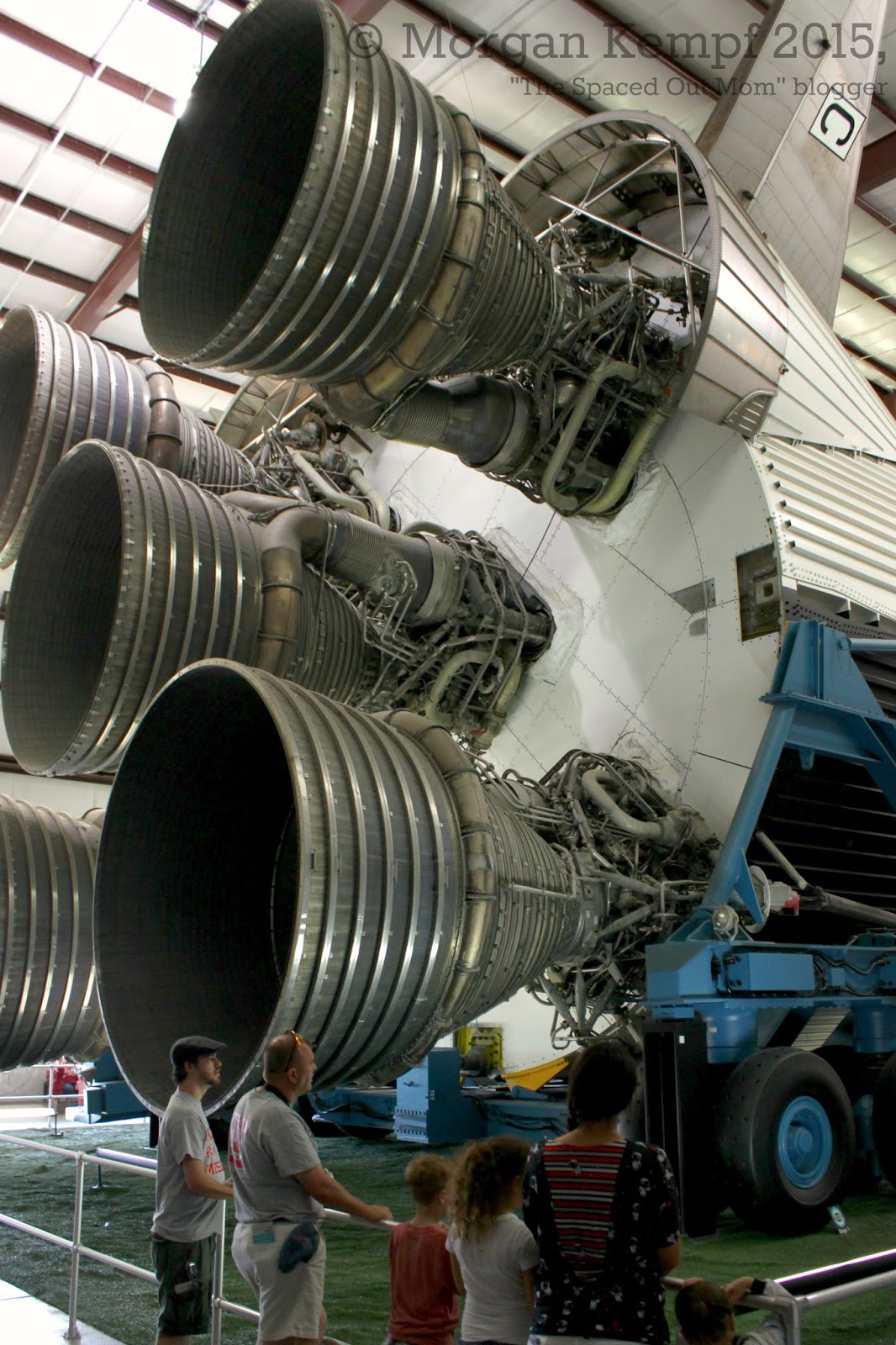


Look at just how massive these thrusters are.  This is what it took to lift three people off the earth in 1969...


And now I attach the raw video footage of Lee Norbraten, guest speaking on the 46th anniversary of the Apollo 11 Lunar Landing.

In this first video clip, Lee details the humble personality and background of Neil Armstrong.  This is an excellent source to cite for quoted commentary for your children's use on school projects.


At 0:35 mark, my recording becomes less wonky. I was not expecting the Apollo Mission Planner himself to be present on this 46th anniversary of the Apollo 11 Moon Landing, so I wasn't prepared for a proper recording.


The audio may be a little unreliable for some devices, but I'm including this third clip anyway.  I can't discard history no matter what the quality...


   And now, last, but not least for sure, is the 4th clip of Lee Norbraten's recall of the Apollo 11 mission: 

I've sifted the video and transcribed a transcript of Lee's telling here if you'd like to read while listening along: 

 
The guidance system was a little bit off. And we didn't end up right over the landing site like we were suppose to. We were about 4 miles down range from the landing site and the astronauts looked down to survey the scene and the only thing they even recognized was this thing called “West Crater” which was out in the far west end of the pictures that they had been looking at as they prepared for landing.
So we're going to have to uh, do a little bit of uh adaptation here (mark 2:28), and we're going to have to pick out another landing site other than the one we had planned so we're going to have to do some -inaudible- and sipping on our propellant and therefore we end up using a little more propellant than we expected. We hope to land with about two to three minutes of reserve propellant as we are uh moving around -inaudible- looking at this spot, looking at that spot, translating over to find a new spot we go through the one and a half minute alarm, the one minute alarm, and even the 30 second alarm goes off and we probably actually had a little more than 30 seconds to execute a landing because of the slosh (mark 3:05) exposed the sensor that said it [the fuel gauge] was dry, when it wasn't really dry, but nonetheless that was the level in the tank that was there. And then to make matters worse, we kept getting these -inaudible- alarms, which is irritating because you're trying to fly your descent and all of a sudden: “rrrrrreerrr!!!” Alarm goes off. It's the “twelve-o-two” alarm meaning that the computer is overloaded. And that happens uh (mark 3:29) really about five different alarms went off in the last three or four minutes of the flight, really irritating, indicating that the computers were overloaded, maybe the guidance wasn't going to work, maybe the computer wasn't going to set you down, uh, at all, but we had this guy on the ground that knew exactly the nature of the alarm that said (mark 3:45) “Continue to go for landing. That's not going to create an issue,” the computer is not going to lock up, so we got the confidence to go ahead and proceed, uh, with the landing. And this is the kind of things that makes Space Flight interesting (mark 3:58). Right? So we finally set down on the surface, uh, like three-seventeen in the afternoon today(mark 4:04), he's looking at his watch), uh, about three and a half hours from now, so there's a lot of check-out that has to happen inside the cabin to be sure that everything is ready -inaudible- to jump out on the surface of the moon. So that's going to be at about nine o'clock, inaudible, when the hatch is first opened, Neil Armstrong comes down the ladder. And makes that step onto the Moon and says, he says, “That's one small step for man, one giant leap for mankind.” But it wasn't really even a small step. They thought that the, uh, that the pads were going to sink deeper into the soil and you'd only have to step down a couple of feet. The pads didn't sink into the soil very far, he had to actually jump three and a half feet down -inaudible- to the surface first. So it was a big step for a guy (mark 4:48), you know and a big leap for mankind, uh, as well. Uh, about ten minutes later, Aldrin follows him outside. They, uh, do all – collect their immediate samples just to be sure that if there's an immediate emergency that they'd be some lunar material to return. And we'd set up experiments. And then we collected about forty-seven pounds of lunar material (mark 5:09), we brought them back onboard and we waited for NASA -inaudible-. Now, as we're getting ready to lift-off, uh, this is going to happen (mark 5:17), a little bit after midnight tonight. Early on the 21st, Houston time, is when we're gonna start back and the entire Lunar Module begins liftoff from the Lunar surface, right most of the fuel from the descent stages are on empty remember we almost used all the propellant, uh, and only the ascent stage is going to return. It's got uh, it's own propellant tanks its own engine. It lifts off and -inaudible- it accelerates, fires in posograde. Catches up with the command module about four hours later. The command module has been in lunar orbit the entire time. And they round up to dock, rejoin back with your crewmate from the command module, you exit the lunar module and then we jettison the lunar module into the orbit so that it hits the surface and now all we've got left is the command module and all three astronauts are now safely back inside and their 47 pounds of rocks. And the surface module -inaudible-...
And we're going to enter the atmosphere, on the 24th of this month, so four days from now, at a fantastic rate of speed. About almost 25,000 miles an hour, re-entering the atmosphere. And that requires a bit of maneuvering on our part to navigate that successfully. Because just like an extraterrestrial particle comes into the atmosphere that fast it just burns up (mark 7:03) you know it just becomes a meteor streaking across the sky. We don't (mark 7:06) want that to happen (mark 7:07) to our astronauts. We have to jettison the surface module about 20 minutes before we enter. -inaudible-
Our command module is the part that is going to return safely. We got a heat shield on the bottom, we're going to back into the atmosphere, front end first, the friction of the heat shield against the atmosphere is going to create heat. Uh, the heat shield is called the (mark 7:30 to 7:35 is inaudible) the surface only will heat up, flake off, heat up, and flake off, and um, this goes on for about five minutes. Where these super huge flakes are flaking around you and heated up to around, oh, thirty-five hundred degrees Fahrenheit. And then after another four or five minutes things finally slow down to the point that we deploy parachutes and splash down, in the water, a hundred and seventy degrees West longitude about thirteen degrees North latitude. Pretty much in the middle of no where because we don't want to land on land. And now if you're on one of these later flights you'll be wonderful because they'll pick you up and put you on the aircraft carrier and sail you off to Hawaii for a couple of days of vacation (mark 8:19) and then you'd come home, but not Apollo 11. Oh no, you might be contaminated with all these extraterrestrial microbes. So you get onto the ship and you go immediately into the isolation chamber (8:30). And, uh, that's where you remain for the next, uh, twenty-one days. And uh, there's this famous picture of President Nixon actually coming out. Landing on the aircraft carrier to greet the astronauts and he can't even shake their hand because they're inside this isolation chamber, with a tiny little window, it's all so sad, so you're going to have to endure this twenty-one initial days of isolation before you can come out (mark 8:56). And then immediately NASA will send you out on this wonderful good will tour, where you're treated like royalty, for the rest of your lives, and that's the Apollo 11 flight.

And that's the end of our NASA tour.  We left enlightened, inspired and sweaty.  I can't imagine leaving any other way.


Thursday, July 23, 2015

A Spacey Pilgrimage to Houston: Part 1

We had such a busy and memorable Monday in Houston that I have to break my recount up in to three posts!


I've been planning this touristy trip to Houston in my mind for 4 years! Back in 2011, we were still stationed in Washington state. When we got the news that my husband was selected for orders in San Antonio we were going home. In retrospect, we really thought this would be a permanent-permanent move, not just PCS “permanent”; my husband's Navy life would end here after this command tour.

(Or so we thought. Oh, what it is to be young....)


Because of our limited outings and “hurry up and wait” lifestyle over our 4 years living in the Pacific Northwest, I was ready (desperate) for the Texas state of mind again. Naturally, my goal was to invest Texan identity within our children by giving them the full Texas experience as soon as they could appreciate it. Amongst many, MANY, MAAANNNYYY, Texan things to do and see, NASA sits at an exalted seat on my list.


We held out on our NASA trip though because NASA is one of those places you have to develop an appreciation for in advance to really enjoy the opportunity to learn and discover at their visitor center. We thought we would have a little more time to build up the suspense of NASA so the kids would be old enough to have that appreciation, but with our Japan PCS coming in a little less than 4 months, we're out of time.


 This NASA trip was actually not the first time we had come. Last month, in June, we made an impromptu stop on the way to a family vacation in Galveston. This was a desperate effort to squeeze NASA into the schedule not knowing if we could make it back before our PCS took us far away from Texas. We had all of our 5 children with us, alas our toddler (whom was exactly 23 months at the time), was not in the mood to cooperate for the tram, so we had to stick to the sights and activities of just the main visitor center. Completely worth it for the young ones! I do regret now not letting the kids do the “Angry Birds, in Space” play place, but we did run out of time. We spent 2 hours checking out all the indoor attractions and simulations. Touching that meteorite was almost a spiritual encounter.
Fun for some, frightening for others!  A simulation activity to experience what it's like to pedal a stationary bike in Space.


As we were walking out, that day in June, I knew we had to go back. I knew exactly what day I had to bring us too. We would leave behind our 4 year old and now, 2 year old, with Grandma over night in San Antonio, and with just our 9 year old, 7 year old and almost 6 year old in tow, we would embark on our own mission to Mission Control on the 46th Anniversary of the Apollo 11 Lunar Landing.


*Disclaimer Insert: Any child under 18 (or man-child under 55), has the potential to experience a sudden decrease in touring tolerance once the Texas heat of July beats down upon them. Go early in the day (doors open at 9am most days) to avoid literal meltdowns on your tram tour. Also, the tram tours have an amazing amount of information shared to you that really won't be fully digested for those under 20 (maybe 25 from my observations of the crowd). I do not recommend this tour for children between 10 months and 30 months of age. As a mother of 5, that is the least behaviorally negotiable age range. It's not the kids' fault, it's their nature to not want to sit still in this part of their toddlerhood. I highly recommend “child wearing” for babies/infants under 10 months too as you cannot bring a stroller onto the tram. I watched several little guys and gals nod off on the soothing sway of the tram ride.*


Because our visit was deliberately planned for July 20th, we took the Blue Tour: “Historic Mission Control and the Saturn V Rocket experience.” As Space Enthusiasts, we've seen all the movies, TV series, documentaries, etc. of the Apollo Missions. In fact, I fell asleep watching Apollo 13 with my husband and sister-in-law the night before. You picture yourself there, at Mission Control or at the launch pad and Mission Control seems so huge, so crowded, and the Launch site is so mindblowingly high, it's hard to really appreciate the size of the rocket.


The beginning of your tram tour, starts as you exit the back of the Visitor Center main building. You're subjected to a voluntary portraiture in front of a green screen. Normally, this is not a must have commemorative souvenir I seek at amusement parks or the like, but this is NASA, so yes, I forked over $30 (well $25, woohoo for Military discounts!), at the end of the tour for our take home photo.


Once the tram is fully boarded, you're on your way!


On the Historic Mission Control tour, our first sight entering the complex is the Saturn V Rocket Hangar (some regard this as a lackluster garage, I however, was extremely impressed).  This is where one of only 3 surviving Saturn V Rockets is housed.  

This Saturn V Rocket sat exposed to the elements for years (from 1977 to 2004).  As Smithsonian Museum property on loan to the Johnson Space Center, proper care and preservation of this historic relic was dependent upon funds from the Smithsonian.  An entire committee pressured the city of Houston to allocate additional funds for a better, permanent home for this rocket, but there was a lot of politics impeding agreeable terms so this "temporary" hangar was built around the disassembled rocket.  


If interested in more discussion on the background of this restoration project you will find this article (and its commentary) 
from The Space Review quite interesting.
Original photo, before my overlay, was found at:
collectSPACE


Oh hey there Longhorns!  I laughed out loud when I saw what the ranch-like fenced area contained to the left of the hangar.  We're so Texas here.  The windmill there has NASA on the vane.


We return to tour inside, but initially the tram passes the hangar on its way to Christopher C. Kraft, Jr. Mission Control.  On the way, tram riders are treated to pre-recorded tales of history from iconic Space celebrities.  As you pass the buildings, on cue, the recording describes the purpose and contents of each facility.  My oldest daughter especially appreciated the commentary on one of the buildings being the location where Space Culinary Arts are developed and tested.  She told me she wants to be the baker of astronaut desserts!  Sounds awesome to me!  

In emulating the common regard Orion inspires in each instance of its mention at Johnson Space Center, I share the captured moment we passed Building 17 which is dedicated to the Orion project.  If you visit NASA sooner than later, you too will notice that all opportunities to boast the upcoming Orion mission are taken.  On both of our NASA trips, the Orion project has been professed with restrained enthusiasm and a twinkle in the eye.


Once we round the corner, we've arrived. 


 The architecture is very 1960s simplistic.  The structure itself has a very familiar minimalism that many buildings I've visited from the 60s share.


But then, you're greeted in the court yard entry with almost an optical illusion of geometric shutters scaling two tiers of the inlet's back wall exterior.  I was not prepared to see such a mesmerizing artistic design nestled in the austerity of the neighborhood.  

I gawked a little longer than I'm proud of, resulting in us entering the building last in the group.  I might have missed some information shared by the tour guide, but it's highly likely I would have been oblivious to what was said anyhow once I saw the mission patches in the wall's length showcase.  


I would have filtered out any range of hearing when I discovered Gordon Cooper and Pete Conrad's watch and patch entering that awe.  ('Gordo' is a favorite of mine on The Astronaut Wives Club series).


The showcase wall ends and then it's time to enter the stairwell and trek three stories to the observation deck of Mission Control.  This is no light climb either and another reason I recommend some form of bodily baby carrier if you have little ones with you.  I took no pictures in the stairwell...  Energy was conserved for navigating our offspring up the stairs with careful speed.

Once we reach the observation room, you look around breathless (maybe literally for some).  The NASA speaker (for our tour, his name was Sam) begins as soon as everyone has taken a seat or is comfortably positioned in the back (we were in the back).  

The size of Mission Control was shockingly small.  Taking in the room like a starstruck fan, I compare my surprise at size to one finally meeting Seth Green in real life and towering over him (Seth, if you're actually gracing my blog with your eyeballs, you're a fantastic actor and I adore how you're using your influence to promote STEM and NASA. You're truly a celebrity worth idolizing, thanks man. Oh, also, we've never met in any way, so I'm just speculating I'd tower over you, I would certainly not pass up an opportunity to find out if I do though).  Looking down and around I notice the retro orange cushioned chairs.  We learn that they're indeed the originals and that even the Queen of England has once throned a seat in the front there. For an instant, with absolutely no hint of aroma either, I wonder just how smothered this room must have been with cigarette smoke in the 60s and 70s.  No doubt this room has been aired out for decades to relinquish the odor it most likely had. To be fair, I suppose orange upholstery in general triggers my recollective smell sensories and I involuntarily smell smoke no matter what setting I'm in.

I picked up a few factoids from Speaker Sam I didn't know before, but mostly I was just trying to wrap my head around this control room having less technology in it to monitor the Moon landings than I held in the palm of my hand... 

Indeed, this is an iPhone 4 in my hand and yes, even this infuriating piece of very outdated cellular technology exceeds the abilities this control room had 46 years ago to the day.  Also, this is the only way to effectively contain your 24 month old on the tour... ;)


Directly to my left, were a pair of phone booths.  Sam informs us that in one of these booths (I didn't catch which booth it was exactly) the World Record for the most long distance call was made.  Any guesses where?


Keeping with my established "last one out" pace, I take advantage of Sam's offer to answer questions at the end.  With me being a seamstress and Space nut, I idolize Hazel Fellows and the rest of the Playtex team of seamstresses that custom sewed each astronaut's space suit under the most tedious specifications any custom garment has ever been required to meet.  I had to ask Sam if any seamstresses had gotten the chance to be in Mission Control during the 8 days of the Apollo 11 mission or at least on standby to materialize (pun intended) in a designated position in the control room to provide suit support if an issue arose.  Being such a specific question he wasn't prepared with a specific answer, but he imagined that some Playtex representative, perhaps not the actual seamstresses themselves of course, if they were present at anytime, would have reported to the Flight Surgeon's station.

I could have sat in there and really soaked the place in, but the tour was moving on now and we needed to catch up.  


On to the Saturn V Rocket Hangar!!!